Encyclopedia entry · Person
Jacob
Curator's research file
Subject · person

Jacob
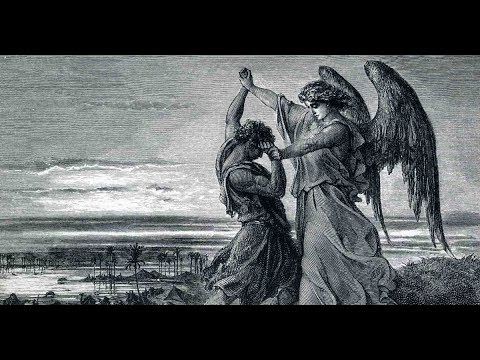
Jacob's Dream · Gustave Doré
Identity
- Name meaning
- Supplanter; one who follows on another's heels (Gen. 25:26; Hos. 12:2–4)
Family
- Parent(s)
- —
- Spouse
- —
- Children
- —
- Tribe / people
- —
Era & origin
- Era
- Patriarchal Period, c. 1837–1690 BC
- Region
- —
- Contemporary of
- —
Role
- Role
- Patriarch; son of Isaac and Rebekah; father of the twelve tribes of Israel
- Notable for
- Jacob, the second-born twin son of Isaac and Rebekah, is one of the three great Hebrew patriarchs whose life story occupies the latter half of Genesis.
Scripture
- First mention
- Gen. 28:10–19
- Most cited
- Genesis 31
Network
- Referenced by
- 159 entries
- Voices
- —
Birth and Early Character
Jacob was born alongside his twin brother Esau, probably at the well of Lahai-roi, around 1837 BC. The very circumstances of his birth foreshadowed his life's defining tension: he emerged from the womb grasping Esau's heel, earning the name Jacob—'supplanter' (Gen. 25:26). Where Esau grew into a rugged, enterprising hunter, Jacob was quieter and domestically inclined, a man of tents and flocks. Yet beneath that calm exterior lay a calculating shrewdness. When Esau returned famished from the fields, Jacob exploited the moment and purchased his brother's birthright for a single meal of bread and lentil stew (Gen. 25:29–34). The birthright was no small thing: it carried a double portion of inheritance, family headship, the priestly role within the clan (Num. 8:17–19), and the covenantal promise that through one of Abraham's descendants all nations would be blessed (Gen. 22:18).
Deception and Flight
The defining scandal of Jacob's early life came when, at his mother Rebekah's instigation, he disguised himself to impersonate Esau and deceive the aged, nearly blind Isaac into giving him the blessing intended for the firstborn (Gen. 27). Jacob received the blessing—but gained it through deceit, and with it came lasting sorrow. It is worth noting, as some editors of the biblical text have observed, that the blessing God had already promised Jacob (Gen. 25:23) would have come in its own time; Jacob and Rebekah's distrust of God's timing led them to grasp it through dishonesty, and the consequences were severe. Esau's fury forced Jacob to flee 400 miles north to Haran, to the household of his uncle Laban, separated from his parents for the rest of his mother's life.
Bethel and the Journey to Haran
As Jacob traveled north alone and vulnerable, God met him at a place he would name Bethel. In a dream he saw a stairway reaching from earth to heaven, with angels ascending and descending upon it, and heard God reaffirm to him the Abrahamic covenant: 'I am the Lord, the God of Abraham your father and the God of Isaac. The land on which you lie I will give to you and to your offspring' (Gen. 28:13). The wandering deceiver was met, not with condemnation, but with covenant grace. This vision at Bethel—and its New Testament echo in Jesus's words about the Son of Man (John 1:51)—reveals that even Jacob's flight was held within the purposes of God. Jacob vowed that if God would be with him, the Lord would be his God, and he set up the stone he had used as a pillow as a pillar, anointing it with oil.
Twenty-One Years in Padan-Aram
In Haran, Jacob met Rachel at a well and loved her immediately. He offered Laban seven years of labor for Rachel's hand—years that 'seemed to him but a few days because of the love he had for her' (Gen. 29:20). But Laban, the craftiest man Jacob would ever meet, deceived him on the wedding night and substituted his older daughter Leah. Jacob then served another seven years for Rachel, and six more years tending Laban's flocks—twenty-one years in total (Gen. 31:41). From these two wives and their servants Bilhah and Zilpah, Jacob fathered eleven sons and a daughter, Dinah. The providence working through this complex, often painful household would eventually produce the twelve tribes of Israel. When Jacob finally set out for Canaan with his family and considerable flocks, Laban pursued him; the two men argued bitterly before making a covenant of separation. As Jacob crossed back into the land of promise, a company of angels met him—a divine welcome home that mirrored the vision at Bethel twenty years before (Gen. 32:1–2).
Wrestling at Jabbok and Reconciliation with Esau
Learning that Esau was approaching with 400 men, Jacob was gripped with fear. He prayed earnestly, sent lavish gifts ahead, and moved his family across the Jabbok River—then spent the night alone. There, in the darkness, a mysterious figure wrestled with him until daybreak (Gen. 32:24–31). Jacob refused to release the man without a blessing; his opponent wrenched Jacob's hip from its socket, yet Jacob clung on. The encounter ended with a new name—Israel, meaning 'one who strives with God'—and Jacob named the place Peniel: 'I have seen God face to face, and yet my life has been delivered' (Gen. 32:30). He went forward into the meeting with Esau limping, physically weakened but spiritually transformed. Esau ran to meet him, embraced him, and the brothers were reconciled. The man who had built his life on grasping and scheming had been broken open—and blessed. Jacob returned to Bethel, built an altar, and God once more confirmed the covenant (Gen. 35:6–7).
Final Years: Egypt and Death
The last decades of Jacob's life were marked by grief and then grace. His daughter Dinah was violated at Shechem; his sons Simeon and Levi took violent revenge; Rachel died giving birth to Benjamin near Bethlehem (Gen. 35:16–20); and then his beloved son Joseph was sold into Egypt by jealous brothers, and Jacob mourned him as dead for over twenty years (Gen. 37:33–35). Yet it was Joseph who, by God's sovereign hand, had risen to power in Egypt and was able to save the entire family from famine. When Jacob descended to Egypt at roughly 130 years of age (Gen. 47:9), he met Pharaoh and settled with his household—about seventy souls in all (Gen. 46:27; Acts 7:14)—in the land of Goshen. He lived there seventeen years in something approaching peace. On his deathbed he blessed each of his twelve sons (Gen. 49), adopting Joseph's two sons Ephraim and Manasseh as his own (Gen. 48:5), and gave detailed, prophetic words over each tribe. He died at 147 years of age. At his own request, his embalmed body was carried in solemn procession back to Canaan and buried alongside Abraham, Sarah, Isaac, Rebekah, and Leah in the cave of Machpelah (Gen. 49:29–50:13). The writer of Hebrews holds up the dying patriarch as a model of faith: 'By faith Jacob, when dying, blessed each of the sons of Joseph, bowing in worship over the head of his staff' (Heb. 11:21).
Key passages
See also
More illustrations of Jacob
14

Jacob Tends Laban's Flocks and Meets Rachel
Gustave Doré
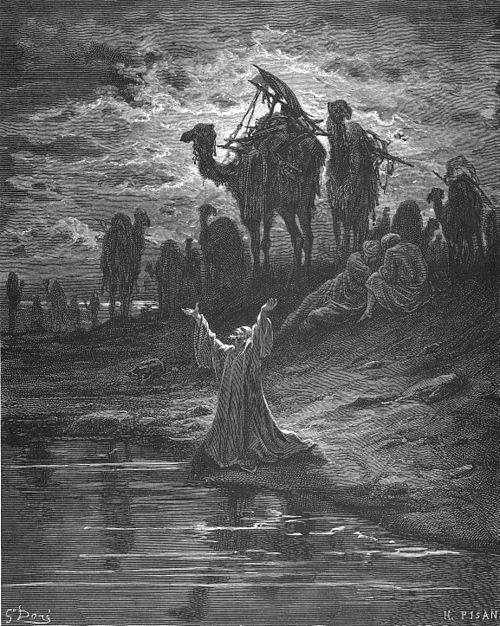
Jacob Prays for Protection
Gustave Doré

Jacob Wrestles with the Angel
Gustave Doré

Jacob and Esau Meet
Gustave Doré

Jacob Goes to Egypt
Gustave Doré

3 403 Jacob prend la place de Esaü (Genesis 27 21) • invenit James Tissot • pinxit James Tissot • excudit Maurice de Brunoff apud Philip de Vere • praesentat Phillip Medhurst
James Tissot

3 402 Le songe de Jacob (Genesis 28 12) • invenit James Tissot • pinxit James Tissot • excudit Maurice de Brunoff apud Philip de Vere • praesentat Phillip Medhurst
James Tissot

3 402 Jacob et Rachel à la fontaine (Genesis 29 9) • invenit James Tissot • pinxit James Tissot • excudit Maurice de Brunoff apud Philip de Vere • praesentat Phillip Medhurst
James Tissot

3 402 La lutte de l'Ange avec Jacob (Genesis 32 24) • invenit James Tissot • pinxit James Tissot • excudit Maurice de Brunoff apud Philip de Vere • praesentat Phillip Medhurst
James Tissot

3 402 Jacob voit venir à lui Esaü (Genesis 33 1) • invenit James Tissot • pinxit James Tissot • excudit Maurice de Brunoff apud Philip de Vere • praesentat Phillip Medhurst
James Tissot

3 402 La rencontre d'Esaü et de Jacob (Genesis 33 4) • invenit James Tissot • pinxit James Tissot • excudit Maurice de Brunoff apud Philip de Vere • praesentat Phillip Medhurst
James Tissot

3 402 La douleur de Jacob (Genesis 37 35) • invenit James Tissot • pinxit James Tissot • excudit Maurice de Brunoff apud Philip de Vere • praesentat Phillip Medhurst
James Tissot

Tissot The Meeting of Esau and Jacob
James Tissot

Jacob Skeen Genealogical Chronological and Geographical Chart 1887 Cornell CUL PJM 2085 03
Historical biblical maps


_%E2%80%A2_invenit_James_Tissot_%E2%80%A2_pinxit_James_Tissot_%E2%80%A2_excudit_Maurice_de_Brunoff_apud_Philip_de_Vere_%E2%80%A2_praesentat_Phillip_Medhurst.jpg)
_%E2%80%A2_invenit_James_Tissot_%E2%80%A2_pinxit_James_Tissot_%E2%80%A2_excudit_Maurice_de_Brunoff_apud_Philip_de_Vere_%E2%80%A2_praesentat_Phillip_Medhurst.jpg)
_%E2%80%A2_invenit_James_Tissot_%E2%80%A2_pinxit_James_Tissot_%E2%80%A2_excudit_Maurice_de_Brunoff_apud_Philip_de_Vere_%E2%80%A2_praesentat_Phillip_Medhurst.jpg)
_%E2%80%A2_invenit_James_Tissot_%E2%80%A2_pinxit_James_Tissot_%E2%80%A2_excudit_Maurice_de_Brunoff_apud_Philip_de_Vere_%E2%80%A2_praesentat_Phillip_Medhurst.jpg)
_%E2%80%A2_invenit_James_Tissot_%E2%80%A2_pinxit_James_Tissot_%E2%80%A2_excudit_Maurice_de_Brunoff_apud_Philip_de_Vere_%E2%80%A2_praesentat_Phillip_Medhurst.jpg)
_%E2%80%A2_invenit_James_Tissot_%E2%80%A2_pinxit_James_Tissot_%E2%80%A2_excudit_Maurice_de_Brunoff_apud_Philip_de_Vere_%E2%80%A2_praesentat_Phillip_Medhurst.jpg)
_%E2%80%A2_invenit_James_Tissot_%E2%80%A2_pinxit_James_Tissot_%E2%80%A2_excudit_Maurice_de_Brunoff_apud_Philip_de_Vere_%E2%80%A2_praesentat_Phillip_Medhurst.jpg)


Source · AI-drafted from public-domain sources (Smith's 1884, Easton's 1897), synthesized + modernized; auto-verified for fidelity. Final gospel.bot review recommended.