Encyclopedia entry · Person
Isaac
Curator's research file
Subject · person

Isaac
Isaac Blesses Jacob · Gustave Doré
Identity
- Name meaning
- Laughter
Family
- Parent(s)
- —
- Spouse
- —
- Children
- —
- Tribe / people
- —
Era & origin
- Era
- Patriarchal period, c. 1897 BC
- Region
- —
- Contemporary of
- —
Role
- Role
- Patriarch; son of Abraham and Sarah; child of promise; type of Christ in sacrifice
- Notable for
- Isaac, whose name means 'laughter,' was the miracle son born to Abraham and Sarah in their extreme old age, fulfilling the covenant promise God had made to Abraham.
Scripture
- First mention
- Genesis 22:1-14
- Most cited
- Genesis 27
Network
- Referenced by
- 53 entries
- Voices
- —
Birth and Early Life
Isaac was born to Abraham when he was one hundred years old and Sarah was well past the age of childbearing, a living proof that nothing is impossible with God (Gen. 21:1–3). His name, meaning 'laughter,' recalls both Sarah's incredulous laughter at the promise and the joy his birth brought. He was circumcised on the eighth day (Gen. 21:4–7), and a great feast was held when he was weaned. Even in infancy his presence stirred conflict: the older Ishmael mocked him, leading Sarah to demand that Hagar and her son be sent away—an episode Paul would later read as deeply symbolic of two covenants (Gal. 4:28–31).
The Offering on Mount Moriah
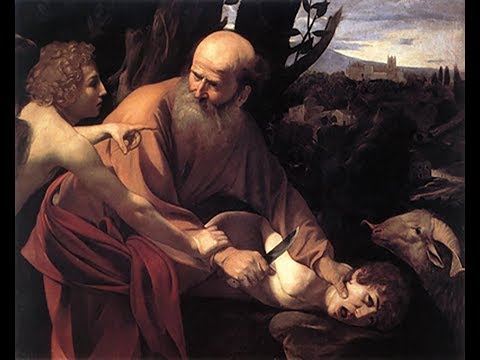
The pivotal event of Isaac's life came when God commanded Abraham to offer him as a burnt offering on a mountain in the land of Moriah (Gen. 22:1–2). Isaac obeyed his father without recorded resistance, even carrying the wood for his own sacrifice—a detail that has long struck readers as profound. At the last moment God provided a ram as a substitute, and the angel of the Lord declared Abraham's obedience a testimony to his faith (Gen. 22:12–13). The New Testament returns to this event repeatedly: the author of Hebrews holds it up as the supreme act of faith, noting that Abraham believed God could raise the dead (Heb. 11:17–19), and James cites it as proof that faith and works are inseparable (James 2:21). Theologically, the ram offered in Isaac's place is the recognized type of 'the Lamb of God who takes away the sin of the world' (John 1:29), and Isaac himself stands as a type of humanity devoted to death for sin and then restored to life.
Marriage to Rebekah
When Isaac was forty years old, Abraham sent his servant to find a wife for Isaac among his own kindred in Mesopotamia rather than from the Canaanites (Gen. 24:1–4). The servant's prayerful journey and Rebekah's generous response at the well make Genesis 24 one of Scripture's richest narratives of divine providence at work in ordinary events. Isaac met Rebekah in the field at evening, and 'he loved her; and Isaac was comforted after his mother's death' (Gen. 24:67). The tenderness of that verse is revealing: Isaac had mourned Sarah deeply, and Rebekah's arrival filled a real grief. Their marriage would prove central to the continuation of the covenant promise.
Sojourn in Gerar and the Wells of Contention
Famine drove Isaac to Gerar, in the territory of the Philistines, where he repeated his father's regrettable deception, passing Rebekah off as his sister out of fear that her beauty would make him a target (Gen. 26:7). King Abimelech rebuked him when the truth was discovered. Yet despite this moral failure, God reaffirmed the Abrahamic covenant to Isaac directly: 'I will make your offspring as numerous as the stars of heaven' (Gen. 26:4). Isaac prospered greatly through his flocks, which provoked the Philistines to stop up the wells Abraham had dug. He patiently moved from place to place—Esek, Sitnah, Rehoboth—refusing to escalate conflicts, until at Beersheba God appeared to him again with fresh assurance, and Abimelech himself sought a peace covenant with him (Gen. 26:17–31). His willingness to yield wells rather than fight for them speaks to a character for whom peace was worth more than possession.
The Blessing and Jacob's Deception
In old age, with his eyesight failing, Isaac intended to bestow the patriarchal blessing on his elder son Esau (Gen. 27:1–4). Rebekah, however, orchestrated a deception by which Jacob disguised himself and received the blessing instead. Isaac's guilelessness is striking: he doubted, questioned, and touched Jacob—yet ultimately was deceived. The Hebrews commentary treats this moment not as failure but as faith: 'By faith Isaac blessed Jacob and Esau in regard to their future' (Heb. 11:20), affirming that even this complicated scene was wrapped up in God's sovereign purposes. Once given, the blessing could not be revoked, and Isaac confirmed it knowingly, sending Jacob to Paddan-aram to find a wife among Rebekah's family (Gen. 28:1–5).
Death and Legacy
Isaac lived to be one hundred and eighty years old, the longest-lived of the three patriarchs, dying at Mamre 'old and full of days' (Gen. 35:28–29). His two sons, Jacob and Esau, buried him together in the cave of Machpelah—the same tomb that held Abraham and Sarah. In the New Testament, Isaac's significance extends beyond his biography: Paul contrasts him with Ishmael as the child of promise versus the child of the flesh (Rom. 9:7; Gal. 4:28), and God himself is called 'the God of Abraham, Isaac, and Jacob'—a title Jesus cites as proof of the resurrection (Matt. 22:32). Isaac embodies a life of quiet faithfulness: rarely dramatic, sometimes faltering, but held firm within the purposes of a covenant-keeping God.
Key passages
See also
More illustrations of Isaac
2

3 402 Isaac porte le bois pour son sacrifice (Genesis 22 6) • invenit James Tissot • pinxit James Tissot • excudit Maurice de Brunoff apud Philip de Vere • praesentat Phillip Medhurst
James Tissot

3 402 Rébecca rencontre sur le chemin Isaac (Genesis 24 65) • invenit James Tissot • pinxit James Tissot • excudit Maurice de Brunoff apud Philip de Vere • praesentat Phillip Medhurst
James Tissot
_%E2%80%A2_invenit_James_Tissot_%E2%80%A2_pinxit_James_Tissot_%E2%80%A2_excudit_Maurice_de_Brunoff_apud_Philip_de_Vere_%E2%80%A2_praesentat_Phillip_Medhurst.jpg)
_%E2%80%A2_invenit_James_Tissot_%E2%80%A2_pinxit_James_Tissot_%E2%80%A2_excudit_Maurice_de_Brunoff_apud_Philip_de_Vere_%E2%80%A2_praesentat_Phillip_Medhurst.jpg)
Source · AI-drafted from public-domain sources (Smith's 1884, Easton's 1897), synthesized + modernized; auto-verified for fidelity. Final gospel.bot review recommended.