
Encyclopedia entry
Camel
Disambiguation
The source enumerates 2 distinct subjects under Camel. Jump to one below, or read in order.
From the Hebrew gamal, “to repay” or “requite,” as the camel does the care of its master. There are two distinct species of camels, having, however, the common characteristics of being “ruminants without horns, without muzzle, with nostrils forming oblique slits, the upper lip divided and separately movable and extensile, the soles of the feet horny, with two toes covered by claws, the limbs long, the abdomen drawn up, while the neck, long and slender, is bent up and down, the reverse of that of a horse, which is arched.”
Camel (1)
#The Bactrian camel is distinguished by two humps. It is a native of the high table-lands of Central Asia.
Camel (2)
#The Arabian camel or dromedary, from the Greek dromos, “a runner” (Isa. 60:6; Jer. 2:23), has but one hump, and is a native of Western Asia or Africa.
The camel was early used both for riding and as a beast of burden (Gen. 24:64; 37:25), and in war (1 Sam. 30:17; Isa. 21:7). Mention is made of the camel among the cattle given by Pharaoh to Abraham (Gen. 12:16). Its flesh was not to be eaten, as it was ranked among unclean animals (Lev. 11:4; Deut. 14:7). Abraham’s servant rode on a camel when he went to fetch a wife for Isaac (Gen. 24:10, 11). Jacob had camels as a portion of his wealth (30:43), as Abraham also had (24:35). He sent a present of thirty milch camels to his brother Esau (32:15). It appears to have been little in use among the Jews after the conquest. It is, however, mentioned in the history of David (1 Chr. 27:30), and after the Exile (Ezra 2:67; Neh. 7:69). Camels were much in use among other nations in the East. The queen of Sheba came with a caravan of camels when she came to see the wisdom of Solomon (1 Kings 10:2; 2 Chr. 9:1). Benhadad of Damascus also sent a present to Elisha, “forty camels’ burden” (2 Kings 8:9).
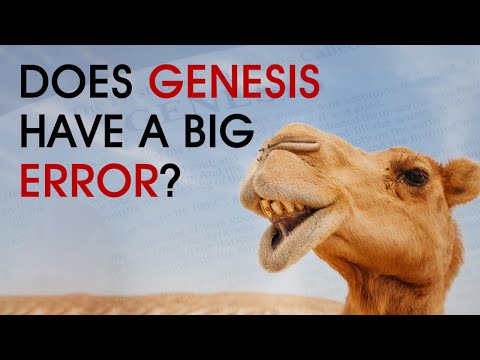
To show the difficulty in the way of a rich man’s entering into the kingdom, our Lord uses the proverbial expression that it was easier for a camel to go through the eye of a needle (Matt. 19:24).
To strain at (rather, out) a gnat and swallow a camel was also a proverbial expression (Matt. 23:24), used with reference to those who were careful to avoid small faults, and yet did not hesitate to commit the greatest sins. The Jews carefully filtered their wine before drinking it, for fear of swallowing along with it some insect forbidden in the law as unclean, and yet they omitted openly the “weightier matters” of the law.
The raiment worn by John the Baptist was made of camel’s hair (Matt. 3:4; Mark 1:6), by which he was distinguished from those who resided in royal palaces and wore soft raiment. This was also the case with Elijah (2 Kings 1:8), who is called “a hairy man,” from his wearing such raiment. “This is one of the most admirable materials for clothing; it keeps out the heat, cold, and rain.” The “sackcloth” so often alluded to (2 Kings 1:8; Isa. 15:3; Zech. 13:4, etc.) was probably made of camel’s hair.
Also from Smith's (1884) +−
The species of camel which was in common use among the Jews and the heathen nations of Palestine was the Arabian or one-humped camel, Camelus arabicus . The dromedary is a swifter animal than the baggage-camel, and is used chiefly for riding purposes; it is merely a finer breed than the other. The Arabs call it the heirie . The speed, of the dromedary has been greatly exaggerated, the Arabs asserting that it is swifter than the horse. Eight or nine miles an hour is the utmost it is able to perform; this pace, however, it is able to keep up for hours together. The Arabian camel carries about 500 pounds. “The hump on the camel’s back is chiefly a store of fat, from which the animal draws as the wants of his system require; and the Arab is careful to see that the hump is in good condition before a long journey. Another interesting adaptation is the thick sole which protects the foot of the camel from the burning sand. The nostrils may be closed by valves against blasts of sand. Most interesting is the provision for drought made by providing the second stomach with great cells in which water is long retained. Sight and smell is exceedingly acute in the camel.”—Johnson’s Encyc. It is clear from (Genesis 12:16) that camels were early known to the Egyptians. The importance of the camel is shown by (Genesis 24:64; 37:25; Judges 7:12; 1 Samuel 27:9; 1 Kings 19:2; 2 Chronicles 14:15; Job 1:3; Jeremiah 49:29,32) and many other texts. John the Baptist wore a garment made of camel hair, (Matthew 3:4; Mark 1:6) the coarser hairs of the camel; and some have supposed that Elijah was clad in a dress of the same stuff.
In the Bible
12
Verses where Camel is named. Berean Standard Bible (public domain).
- 1 Samuel 15:3
Now go and attack the Amalekites and devote to destruction all that belongs to them. Do not spare them, but put to death men and women, children and infants, oxen and sheep, camels and donkeys.’”
- 2 Kings 8:9
So Hazael went to meet Elisha, taking with him a gift of forty camel loads of every good thing from Damascus. And he went in and stood before him and said, “Your son Ben-hadad king of Aram has sent me to ask, ‘Will I recover from this illness?’”
- Deuteronomy 14:7
But of those that chew the cud or have a completely divided hoof, you are not to eat the following: the camel, the rabbit, or the rock badger. Although they chew the cud, they do not have a divided hoof. They are unclean for you,
- Genesis 24:64
And when Rebekah looked up and saw Isaac, she got down from her camel
- Genesis 31:34
Now Rachel had taken Laban’s household idols, put them in the saddlebag of her camel, and was sitting on them. And Laban searched everything in the tent but found nothing.
- Jeremiah 2:23
“How can you say, ‘I am not defiled; I have not run after the Baals’? Look at your behavior in the valley; acknowledge what you have done. You are a swift young she-camel galloping here and there,
+6 more verses naming Camel.
Scripture on Camel
32
Entries that reference Camel
2
Camel references
27
Voices on Camel
3
Surfaced by name match — accuracy varies by title clarity.

![Search the Scriptures Live - A Camel Going Through the Eye of a Needle? [Matthew #85]](https://i.ytimg.com/vi/_cUsx_tKtsA/hqdefault.jpg)


Sources · Easton's Bible Dictionary (1897) · Smith's Bible Dictionary (1884)
Public-domain text. Modernized only where archaic spelling impedes reading; original facts preserved. Verify against an authoritative modern reference before quoting.