Encyclopedia entry · Person
David
Curator's research file
Subject · person

David
071A.David Slays Goliath · Gustave Doré
Identity
- Name meaning
- Well-beloved
Family
- Parent(s)
- —
- Spouse
- —
- Children
- —
- Tribe / people
- —
Era & origin
- Era
- c. 1085–1015 BC (United Monarchy)
- Region
- —
- Contemporary of
- —
Role
- Role
- Second king of Israel, ancestor of Christ, psalmist and prophet
- Notable for
- David, son of Jesse, rose from obscure shepherd boy to Israel's greatest king—warrior, poet, and man after God's own heart.
Scripture
- First mention
- 1 Samuel 16:11–13
- Most cited
- 1 Samuel 17
Network
- Referenced by
- 629 entries
- Voices
- —
Shepherd, Musician, and Anointed One
David was born in Bethlehem around 1085 BC, the youngest of Jesse's ten children. When God sent the prophet Samuel to anoint a new king, every older brother passed before Samuel without divine approval; only then did Jesse send for the youngest, who was out keeping the sheep (1 Samuel 16:11). Samuel poured oil over the ruddy, bright-eyed boy on the spot—and from that day on the Spirit of the LORD rushed upon David (1 Samuel 16:13). Returned to his flock, David spent his formative years honing the skills that would define him: music and poetry that would later fill the Psalter, and raw physical courage demonstrated when he fought off a lion and a bear to protect his father's flocks (1 Samuel 17:34–35).
Goliath and the Rise to Fame
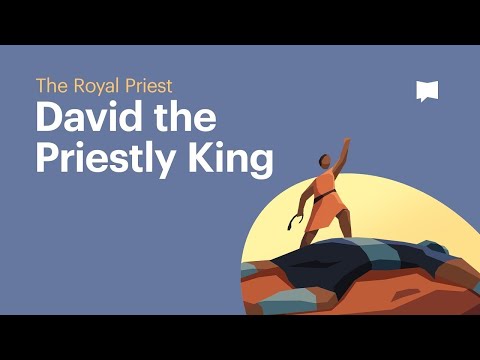
David's introduction to the wider nation came dramatically on the battlefield. When the Philistine giant Goliath mocked Israel's armies with a daily challenge, David arrived at camp carrying provisions for his brothers and could not tolerate the defiance. Armed with only a sling and five smooth stones, he ran toward Goliath and felled him with a single shot (1 Samuel 17:40–51). The victory was more than personal heroism; it became the turning point of David's life. Saul summoned him permanently to court, promoted him first to armor-bearer and then to captain over a thousand, and eventually gave him his daughter Michal in marriage—a position second in prestige only to Abner, commander of the army, and Jonathan the crown prince (1 Samuel 18:13).
Fugitive and Man on the Run
David's fame proved dangerous. His popular acclaim—Saul has struck down his thousands, and David his ten thousands (1 Samuel 18:7)—ignited a jealousy in Saul that mixed with the king's deteriorating mental state and became a murderous obsession. Protected by the loyalty of Jonathan and Michal, David eventually escaped by night and became a fugitive. He briefly sought refuge among the Philistines, only to feign madness to escape when his identity was recognized (1 Samuel 21:13). He retreated to the cave of Adullam, where his family joined him, and a band of roughly four hundred discontented men gathered around him—the nucleus of his future army (1 Samuel 22:1–2). For years Saul hunted him like a partridge in the mountains (1 Samuel 26:20), yet David twice spared the king's life, refusing to strike the LORD's anointed.
King of Judah and Then All Israel
When news arrived of the catastrophic battle of Gilboa—the deaths of Saul and Jonathan—David's grief was genuine and profound. His lament, recorded in 2 Samuel 1, is among the most moving elegies in Scripture: How the mighty have fallen! (2 Samuel 1:27). He was anointed king over Judah at Hebron, where he reigned for seven and a half years (2 Samuel 2:4; 5:5). A civil war between David's house and the remnant loyal to Saul's son Ish-bosheth eventually collapsed following the murders of Abner and Ish-bosheth. The united nation then called David to the throne, and he was anointed king a third time in a celebration lasting three days (1 Chronicles 12:39).
Jerusalem, Empire, and the Davidic Covenant
One of David's first acts as king of all Israel was to capture Jerusalem from the Jebusites, establishing it as his royal capital—the city of David (2 Samuel 5:9). He then brought the Ark of the Covenant to Jerusalem with great ceremony, intent on placing the worship of God at the heart of national life. Over the following decade he subdued the Philistines to the west (2 Samuel 8:1), the Moabites to the east (2 Samuel 8:2), the Syrians as far as the Euphrates (2 Samuel 8:3), and the Edomites and Ammonites to the south and east—fulfilling something close to the ancient territorial promise of Genesis 15:18–21. Though God denied David the privilege of building the Temple because he was a man of war, God gave him something far greater: an eternal covenant promising that his dynasty and throne would endure forever (2 Samuel 7:16), a promise the New Testament understands as ultimately fulfilled in Jesus Christ (Luke 1:32–33).
Failure, Consequence, and Lasting Legacy
The darkest chapter of David's reign began with his adultery with Bathsheba and his calculated engineering of her husband Uriah's death in battle—a double sin the prophet Nathan confronted with searing directness: You are the man (2 Samuel 12:7). David repented deeply (Psalm 51 is traditionally associated with this moment), and God forgave him, but the consequences were severe. Nathan declared that the sword shall never depart from your house (2 Samuel 12:10), and the rest of David's reign bore that out: the rape of Tamar, the murder of Amnon, the rebellion of Absalom, and ongoing political instability. Three great calamities—a three-year famine, a three-month flight from Absalom, and a three-day pestilence following a forbidden census—mark the troubled latter years of his otherwise glorious reign (2 Samuel 24:13). He died peacefully, charging his son Solomon to walk in God's ways, and was buried in Jerusalem. The New Testament opens by identifying Jesus as the son of David (Matthew 1:1), the one in whom every promise made to the shepherd-king finds its eternal fulfillment.
Key passages
See also
More illustrations of David
9

David Escapes through a Window
Gustave Doré

073A.David and Jonathan
Gustave Doré

David Shows Saul How He Spared His Life
Gustave Doré

David Attacks the Ammonites
Gustave Doré

David Mourns the Death of Absalom
Gustave Doré

David Mourns His Son Amnon by J.Tissot
James Tissot

David returns to Achish
James Tissot

Bible Žalmista David
Julius Schnorr von Carolsfeld

Combat between Soldiers of Ish-bosheth and David
Gustave Doré


Source · AI-drafted from public-domain sources (Smith's 1884, Easton's 1897), synthesized + modernized; auto-verified for fidelity. Final gospel.bot review recommended.