Encyclopedia entry · Person
Abraham
Curator's research file
Subject · person

Abraham
also called Abram
Abraham Goes to the Land of Canaan · Gustave Doré
Identity
- Name meaning
- father of a multitude (Heb. avraham) — originally Abram (av-ram, *exalted father*)
Family
- Parent(s)
- —
- Spouse
- —
- Children
- —
- Tribe / people
- —
Era & origin
- Era
- c. 2166–1991 BC (traditional)
- Region
- —
- Contemporary of
- —
Role
- Role
- Patriarch · Father of the faithful · Recipient of God's covenant with Israel
- Notable for
- **I.
Scripture
- First mention
- Genesis 12
- Most cited
- Genesis 21
Network
- Referenced by
- 171 entries
- Voices
- —
Read the full account →↑
I. Name. Born *Abram* — Hebrew av-ram, exalted father — he was renamed by God in the ninety-ninth year of his life: Neither shall thy name any more be called Abram, but thy name shall be Abraham; for a father of many nations have I made thee (Genesis 17:5). The new name folds in the Hebrew hamon, multitude, anticipating descendants as the stars of the heaven for number. The renaming is the formal seal of God's covenant. He is called Abraham in scripture from Genesis 17 onward; Abram before. The New Testament uses only the second name.
**II. Chronology.** The traditional dating — which the apostle Paul affirms in his framework of four hundred and thirty years from the promise to the law (Galatians 3:17) — places Abraham's life c. 2166–1991 BC, though scholars dispute the absolute dates by a century or more in either direction. He was born in Ur of the Chaldees, migrated north with his father Terah to Haran, and was called by God to Canaan at age seventy-five. Isaac was born when Abraham was one hundred (Genesis 21:5). He died at one hundred and seventy-five and was buried in the cave of Machpelah beside Sarah (Genesis 25:7-10).
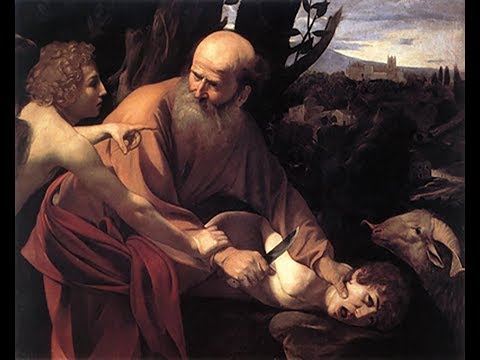
III. Life. The narrative of Abraham occupies thirteen chapters of Genesis (12–25), the most sustained biography in the book. Called out of Ur, he travels first to Haran, then south into Canaan; famine drives him to Egypt where he passes Sarah off as his sister to Pharaoh (Genesis 12). He separates from his nephew Lot and settles at Mamre by Hebron. When Lot is taken captive by a coalition of four kings, Abraham rallies three hundred and eighteen trained men of his household, defeats the coalition at Dan, and rescues Lot — returning to be blessed by the mysterious priest-king *Melchizedek of Salem*, to whom he gives a tithe (Genesis 14). God cuts a covenant with him in a vision of smoke and fire (Genesis 15) — the moment Paul will later cite as the foundation of justification by faith. At Sarah's urging he takes the Egyptian Hagar and fathers Ishmael (Genesis 16). The covenant is renewed and circumcision instituted in chapter 17; the three visitors come to Mamre in chapter 18 and announce Isaac's birth within the year, after which Abraham intercedes for Sodom in the most famous bargaining prayer in scripture. Sodom and Gomorrah fall (Genesis 19). At Gerar he repeats the she is my sister deception, this time with King Abimelech (Genesis 20). Isaac is born in chapter 21; Hagar and Ishmael are sent away with bread and water and a divine promise of their own nation. Then chapter 22: the binding of Isaac on Mount Moriah, the hardest scene in Genesis and the central typological pre-figuring of the cross. Sarah dies; Abraham purchases the cave of Machpelah from Ephron the Hittite as a burying place (Genesis 23). He sends his servant back to Mesopotamia to find a wife for Isaac, and Rebekah is brought home (Genesis 24). He marries Keturah, fathers six more sons by her — including Midian, ancestor of the Midianites — and dies, an old man and full of years (Genesis 25). His sons Isaac and Ishmael bury him together at Machpelah.
IV. Religious Significance. Abraham is the foundation figure of the entire biblical revelation. The covenant God cut with him in Genesis 15 — land, offspring, blessing through him to all the families of the earth — runs through the rest of scripture as a single thread. Paul makes Abraham the father of all them that believe (Romans 4:11), arguing that justification by faith was given to Abraham four hundred and thirty years before the law of Moses existed; what saved Abraham saves the believer in Christ on identical terms. James draws Abraham as the model of faith made visible in works (James 2:21-24). Jesus identifies himself as the one Abraham rejoiced to see my day (John 8:56) — and adds, devastatingly, Before Abraham was, I am. The binding of Isaac becomes one of scripture's central typological scenes: a father climbing a mountain with his only son, an ordered set of wood, and a substitute provided. Hebrews 11 names Abraham first among the heroes of faith — of whom the world was not worthy.
The Bible also calls Abraham the friend of God — a title used three times: Isaiah 41:8, 2 Chronicles 20:7, and James 2:23. He stands at the head of the three monotheistic religions descended from him through Isaac (Judaism, Christianity) and Ishmael (Islam), though scripture itself frames the line of promise as running through Isaac and Jacob to Israel and through Christ to the church.
Key passages
See also
More illustrations of Abraham
10

Abraham and the Three Angels
Gustave Doré

Abraham Sends Hagar and Ishmael Away
Gustave Doré

Abraham et les trois Anges (Genesis 18 2) • invenit James Tissot • pinxit James Tissot • excudit Maurice de Brunoff apud Philip de Vere • praesentat Phillip Medhurst.
James Tissot

3 402 Agar quitte Abraham (Genesis 21 14) • invenit James Tissot • pinxit James Tissot • excudit Maurice de Brunoff apud Philip de Vere • praesentat Phillip Medhurst
James Tissot

Tissot God Renews His Promises to Abraham
James Tissot

Map of sacred geography by Abraham Ortelius
Historical biblical maps

A map of the Land of Canaan or Holy Land, as divided among the twelve tribes which God promised to Abraham and his seed LOC 2016586537
Historical biblical maps

Nouvelles promesses de Dieu à Abraham (Genesis 17 19) • invenit James Tissot • pinxit James Tissot • excudit Maurice de Brunoff apud Philip de Vere • praesentat Phillip Medhurst.
James Tissot

Terre de Chanaan ou terre promise à Abraham et à sa postérité ; Carte des voiages d'Abraham faits par l'ordre de Dieu, en Asie et en Egypte où sont les pays dont il lui promit la possession et à sa... - btv1b59635177
Historical biblical maps

Terre de Chanaan ou Terre Promise à Abraham et à sa postérité... - Cette Carte sert pour la Lecture du Pentateuque, Elle est dressée sur les manuscrits de G. Sanson Geogr. du Roi - Par le Sr. Robert... - btv1b59732288
Historical biblical maps


_%E2%80%A2_invenit_James_Tissot_%E2%80%A2_pinxit_James_Tissot_%E2%80%A2_excudit_Maurice_de_Brunoff_apud_Philip_de_Vere_%E2%80%A2_praesentat_Phillip_Medhurst..jpg)
_%E2%80%A2_invenit_James_Tissot_%E2%80%A2_pinxit_James_Tissot_%E2%80%A2_excudit_Maurice_de_Brunoff_apud_Philip_de_Vere_%E2%80%A2_praesentat_Phillip_Medhurst.jpg)


_%E2%80%A2_invenit_James_Tissot_%E2%80%A2_pinxit_James_Tissot_%E2%80%A2_excudit_Maurice_de_Brunoff_apud_Philip_de_Vere_%E2%80%A2_praesentat_Phillip_Medhurst..jpg)
.jpg)

Source · AI-drafted from biblical text and standard reference works (Smith's, Easton's, ISBE) — verify and refine against authoritative sources before publication.