Encyclopedia entry · Person
Adam
Curator's research file
Subject · person

Adam
Adam and Eve Are Driven out of Eden · Gustave Doré
Identity
- Name meaning
- Red earth (Hebrew: adamah); earthy, red
Family
- Parent(s)
- —
- Spouse
- —
- Children
- —
- Tribe / people
- —
Era & origin
- Era
- Creation / Antediluvian
- Region
- —
- Contemporary of
- —
Role
- Role
- First man, father of the human race
- Notable for
- Adam was the first human being, formed by God from the dust of the ground and made uniquely in the divine image, setting him apart from every other creature.
Scripture
- First mention
- Genesis 1:26-27
- Most cited
- Genesis 3
Network
- Referenced by
- 33 entries
- Voices
- —
Name and Identity
The name Adam comes from the Hebrew adamah (ground or red earth), a fitting reminder that God formed man of dust from the ground (Gen. 2:7). The same Babylonian and Assyrian root carries the same meaning, underscoring how ancient this name truly is. Importantly, the name was not at first exclusively masculine: God created man [Adam] in his own image…male and female created he them, and called their name Adam (Gen. 5:2). The word functioned much like the Latin homo—a term for humanity as a whole before it narrowed to identify the individual.
Creation and Commission
Adam was the crowning act of the sixth day of creation, formed in a manner unlike any other creature: God personally breathed into his nostrils the breath of life (Gen. 2:7) and gave him dominion over every living thing (Gen. 1:26). He was not born but created—fully formed in body and spirit, yet innocent and inexperienced. God then placed him in the Garden of Eden to dress it and to keep it (Gen. 2:15), granting him authority to eat from every tree except one. His first recorded act was giving names to the animals, an exercise of the royal dominion God had conferred on him.
Eve and the First Marriage
Observing that it was not good for the man to be alone, God caused a deep sleep to fall on Adam, took one of his ribs, and fashioned it into a woman whom he brought to the man. Adam's response is the Bible's first recorded human speech: 'This is now bone of my bones and flesh of my flesh; she shall be called Woman, because she was taken out of Man' (Gen. 2:23). He later called her Eve, meaning 'mother of all living.' Together they lived in the garden unashamed, an image of intimacy and wholeness before sin entered the world.
The Fall and Its Consequences
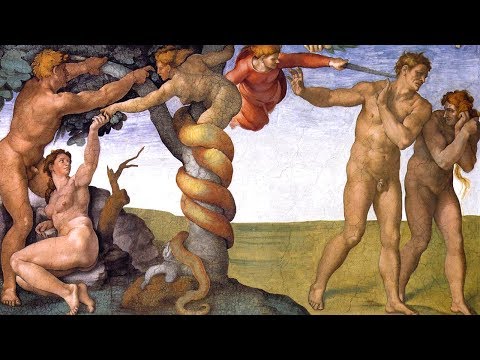
Beguiled by the serpent, Eve ate from the one forbidden tree—the tree of the knowledge of good and evil—and gave fruit to her husband, who also ate (Gen. 3:6). The tree's name proved immediately apt: self-consciousness was the first fruit of their sin. Their eyes were opened and they knew that they were naked. Expelled from Eden, Adam and all his descendants inherited the consequences of that rebellion. Yet even God's prohibition against the tree of life in their fallen state may reflect mercy—for indestructible life locked into a condition of sin and misery would have been the cruelest curse of all.
The First Gospel Promise
Even as God pronounced the curse, divine grace broke through. God declared to the serpent, 'I will put enmity between you and the woman, and between your offspring and her offspring; he shall bruise your head, and you shall bruise his heel' (Gen. 3:15). Theologians have long called this the protoevangelium—the first gospel. It opened a door of hope for Adam, Eve, and every descendant after them. The apostle Paul would later develop the full weight of this promise, contrasting Adam's transgression with Christ's obedience: 'For as in Adam all die, so also in Christ shall all be made alive' (1 Cor. 15:22).
Legacy and Historical Significance
Adam lived 930 years (Gen. 5:5). Scripture names three of his sons—Cain, Abel, and Seth—though Genesis notes he had other sons and daughters as well (Gen. 5:4). As the progenitor of the entire human race, Adam stands at the headwaters of all human history. The New Testament treats him as a real historical figure: Paul grounds both universal sinfulness and universal need for redemption in Adam's single act (Rom. 5:12). Scientific and historical evidence alike points to the unity of the human family—Paul's declaration before the Areopagus remains apt: God 'hath made of one blood all nations of men to dwell on all the face of the earth' (Acts 17:26).
Key passages
See also
More illustrations of Adam
5

Adam et Éve dans le Paradis terrestre (Genesis 2 25) • invenit James Tissot • pinxit James Tissot • excudit Maurice de Brunoff apud Philip de Vere • praesentat Phillip Medhurst.
James Tissot

Adam et Éve s'aperçoivent qu'ils sont nus (Genesis 3 7) • invenit James Tissot • pinxit James Tissot • excudit Maurice de Brunoff apud Philip de Vere • praesentat Phillip Medhurst.
James Tissot

Adam et Éve chassés du Paradis terrestre (Genesis 3 24) • invenit James Tissot • pinxit James Tissot • excudit Maurice de Brunoff apud Philip de Vere • praesentat Phillip Medhurst.
James Tissot

James Jacques Joseph Tissot - Adam and Eve Driven From Paradise - Google Art Project
James Tissot

James Jacques Joseph Tissot - Adam and Eve Driven From Paradise - Google Art ProjectFXD
James Tissot
_%E2%80%A2_invenit_James_Tissot_%E2%80%A2_pinxit_James_Tissot_%E2%80%A2_excudit_Maurice_de_Brunoff_apud_Philip_de_Vere_%E2%80%A2_praesentat_Phillip_Medhurst..jpg)
_%E2%80%A2_invenit_James_Tissot_%E2%80%A2_pinxit_James_Tissot_%E2%80%A2_excudit_Maurice_de_Brunoff_apud_Philip_de_Vere_%E2%80%A2_praesentat_Phillip_Medhurst..jpg)
_%E2%80%A2_invenit_James_Tissot_%E2%80%A2_pinxit_James_Tissot_%E2%80%A2_excudit_Maurice_de_Brunoff_apud_Philip_de_Vere_%E2%80%A2_praesentat_Phillip_Medhurst..jpg)


Source · AI-drafted from public-domain sources (Smith's 1884, Easton's 1897), synthesized + modernized; auto-verified for fidelity. Final gospel.bot review recommended.