Encyclopedia entry · Person
Eve
Curator's research file
Subject · person

Eve
Tissot Adam Is Tempted by Eve · James Tissot
Identity
- Name meaning
- Life; living; enlivening
Family
- Parent(s)
- —
- Spouse
- —
- Children
- —
- Tribe / people
- —
Era & origin
- Era
- Creation / Antediluvian
- Region
- —
- Contemporary of
- —
Role
- Role
- First woman; wife of Adam; mother of Cain, Abel, and Seth
- Notable for
- Eve was the first woman, created by God from Adam's side as his perfect counterpart and companion.
Scripture
- First mention
- Genesis 2:21–22
- Most cited
- Genesis 3
Network
- Referenced by
- 11 entries
- Voices
- —
Creation: Bone of His Bone
The account of Eve's creation in *Genesis 2:21–22* is striking in its intimacy: God caused Adam to fall into a deep sleep, took one of his ribs, and fashioned it into a woman. God himself then brought her to the man—a detail that prompted commentator Matthew Henry's famous observation that she was taken 'not from his head, lest she should rule over him; nor from his feet, lest he should tyrannize over her; but from his side, to denote that species of equality which is to subsist in the marriage state.' The narrative is meant to teach us that marriage rests on identity of nature and oneness of origin: Adam's immediate recognition of Eve—'This is now bone of my bones and flesh of my flesh' (Gen. 2:23)—is the biblical foundation for the lifelong, exclusive union of husband and wife.
The Name 'Eve'
Adam named his wife Eve—Ḥawwāh in Hebrew—meaning 'life' or 'living one' (Gen. 3:20). The name was given after the Fall, yet it was not given in bitterness; it was an act of faith. Even standing in the shadow of God's judgment, Adam looked at his wife and called her the mother of all the living, trusting that God's word of judgment would not be the final word. Her very name is a confession that life would continue and, by implication, that the promised seed would come.
The Temptation and the Fall
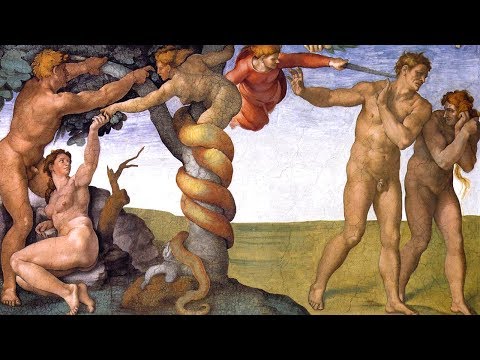
Eve's transgression is one of the most consequential moments in Scripture. The serpent approached her with a question designed to distort God's character—casting doubt on whether God had truly said what he said, and implying that obedience was merely a strategy to keep her from something better. Eve was deceived (Paul is careful to note this distinction in *1 Timothy 2:13–14), ate the forbidden fruit, and gave some to her husband. Paul returns to this event in 2 Corinthians 11:3*, warning believers that their minds might similarly 'be corrupted from the simplicity that is in Christ,' just as Eve was beguiled by the serpent's cunning. The Fall was real, its causes were real, and its consequences—pain, enmity, toil, and death—affected all of creation.
The Protoevangelium: First Glimpse of Hope
Before pronouncing judgment on humanity, God addressed the serpent with words that have echoed through all of biblical theology: 'I will put enmity between you and the woman, and between your offspring and hers; he will crush your head, and you will strike his heel' (Gen. 3:15). This is the protoevangelium—the first gospel, the first promise of a Redeemer. Eve stood at its very center. The serpent had targeted the woman; God's answer was to make the woman the vessel through whom the Conqueror would come. In this way, the one who was deceived became, by grace, the mother of the line of promise.
Motherhood and Faith
When Eve gave birth to Cain, her first recorded words were a declaration of faith: 'I have gotten a man with the help of the Lord' (Gen. 4:1). Some interpreters believe she may have hoped Cain was the promised Seed himself—a hope that would be tragically disappointed. Her story continues through Abel and then Seth, whose birth she greeted by saying, 'God has appointed for me another offspring instead of Abel' (Gen. 4:25). Eve experienced the full range of human parenthood: the joy of new life, the horror of the first murder, and the sustaining mercy of God who gave her another son. Scripture's account of Eve closes quietly with the birth of Seth, yet the line of promise she carried would stretch all the way to Christ.
Eve in Christian Theology
Christian theology has consistently read Eve's story alongside Mary's. Where Eve's disobedience brought death into the world, Mary's obedience opened the way for the one who would defeat death—a parallel drawn by early church fathers such as Irenaeus. Paul's references to Eve (1 Tim. 2:13–15; 2 Cor. 11:3) treat her story as historically real and theologically instructive, not merely symbolic. Her creation establishes the dignity and equality of women; her deception warns against spiritual naïveté; and her reception of the first messianic promise reminds us that God's redemptive purposes are never derailed by human failure. Eve is, in the fullest sense, the mother of all the living—and the first to hear that living was still possible.
Key passages
See also
More illustrations of Eve
8

Tissot Adam and Eve Driven from Paradise
James Tissot

Adam and Eve Are Driven out of Eden
Gustave Doré

Adam et Éve dans le Paradis terrestre (Genesis 2 25) • invenit James Tissot • pinxit James Tissot • excudit Maurice de Brunoff apud Philip de Vere • praesentat Phillip Medhurst.
James Tissot

Adam et Éve s'aperçoivent qu'ils sont nus (Genesis 3 7) • invenit James Tissot • pinxit James Tissot • excudit Maurice de Brunoff apud Philip de Vere • praesentat Phillip Medhurst.
James Tissot

Adam et Éve chassés du Paradis terrestre (Genesis 3 24) • invenit James Tissot • pinxit James Tissot • excudit Maurice de Brunoff apud Philip de Vere • praesentat Phillip Medhurst.
James Tissot

James Jacques Joseph Tissot - Adam and Eve Driven From Paradise - Google Art Project
James Tissot

James Jacques Joseph Tissot - Adam and Eve Driven From Paradise - Google Art ProjectFXD
James Tissot

Tentation d'Adam par Éve (Genesis 3 6) • invenit James Tissot • pinxit James Tissot • excudit Maurice de Brunoff apud Philip de Vere • praesentat Phillip Medhurst.
James Tissot


_%E2%80%A2_invenit_James_Tissot_%E2%80%A2_pinxit_James_Tissot_%E2%80%A2_excudit_Maurice_de_Brunoff_apud_Philip_de_Vere_%E2%80%A2_praesentat_Phillip_Medhurst..jpg)
_%E2%80%A2_invenit_James_Tissot_%E2%80%A2_pinxit_James_Tissot_%E2%80%A2_excudit_Maurice_de_Brunoff_apud_Philip_de_Vere_%E2%80%A2_praesentat_Phillip_Medhurst..jpg)
_%E2%80%A2_invenit_James_Tissot_%E2%80%A2_pinxit_James_Tissot_%E2%80%A2_excudit_Maurice_de_Brunoff_apud_Philip_de_Vere_%E2%80%A2_praesentat_Phillip_Medhurst..jpg)


_%E2%80%A2_invenit_James_Tissot_%E2%80%A2_pinxit_James_Tissot_%E2%80%A2_excudit_Maurice_de_Brunoff_apud_Philip_de_Vere_%E2%80%A2_praesentat_Phillip_Medhurst..jpg)
Source · AI-drafted from public-domain sources (Smith's 1884, Easton's 1897), synthesized + modernized; auto-verified for fidelity. Final gospel.bot review recommended.