Encyclopedia entry · Person
Cain
Curator's research file
Subject · person

Cain
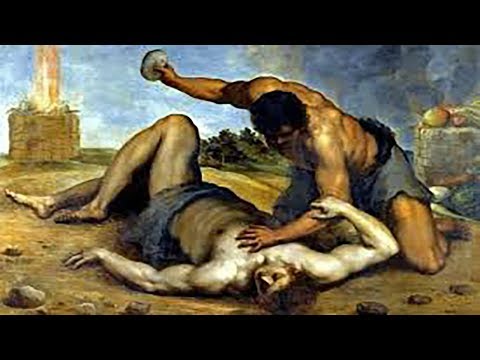
Cain Slays Abel · Gustave Doré
Identity
- Name meaning
- Possession, or possessed; a spear
Family
- Parent(s)
- —
- Spouse
- —
- Children
- —
- Tribe / people
- —
Era & origin
- Era
- Antediluvian (primordial)
- Region
- —
- Contemporary of
- —
Role
- Role
- Firstborn son of Adam and Eve; first murderer
- Notable for
- Cain was the eldest son of Adam and Eve and humanity's first farmer — and, tragically, the perpetrator of the first murder recorded in Scripture.
Scripture
- First mention
- Genesis 4:1-16
- Most cited
- Genesis 4
Network
- Referenced by
- 21 entries
- Voices
- —
Birth and Character
Cain entered the world as the firstborn of Adam and Eve (Gen. 4:1), and from the outset his life was shaped by the ground he worked. He became a tiller of the soil while his younger brother Abel tended flocks. Ancient readers and modern commentators alike have noted that the biblical portrait of Cain is a dark one: sullen, self-willed, haughty, and vindictive, he was a man whose character lacked the essential religious element of humble dependence on God. Even before the murder, this spiritual deficit set the trajectory of his life.
The Rejected Offering
In the course of time — the Hebrew margin suggests literally "at the end of days," possibly indicating a regular Sabbath observance — both brothers brought offerings before the Lord. Abel presented the firstlings of his flock and their fat, the choicest he had, while Cain brought an offering of the fruit of the ground (Gen. 4:3–4). Abel's sacrifice was regarded as "more excellent" (*Heb. 11:4), and God accepted it. The New Testament clarifies the deeper issue: "Not as Cain, who was of that wicked one, and slew his brother. And wherefore slew he him? Because his own works were evil, and his brother's righteous"* (1 John 3:12). The contrast was not merely ritual but moral and spiritual.
The First Murder
When God showed favor to Abel's offering but not to his own, Cain became "very wroth, and his countenance fell" (Gen. 4:5). Rather than responding to God's gentle challenge — "If you do well, will you not be accepted?" (Gen. 4:7) — Cain nurtured his hatred until it consumed him. He lured his brother into a field and killed him, becoming the perpetrator of the first murder in human history. When God confronted him with the question "Where is Abel your brother?" Cain answered with the infamous, defiant reply, "I do not know. Am I my brother's keeper?" (Gen. 4:9). The blood of Abel, Scripture says, cried out from the ground to God.
Curse, Mark, and Exile
God's judgment on Cain was severe: the ground would no longer yield its strength to him, and he would be "a fugitive and a wanderer on the earth" (Gen. 4:12). Cain's response was a cry of anguish — he feared that anyone who found him would kill him. In a remarkable display of divine restraint, God set a mark on Cain so that no one who encountered him would take his life, and he promised sevenfold vengeance on any who harmed him (Gen. 4:15). The precise nature of this "mark" is not specified in Scripture, and interpretations have varied widely throughout history; what is clear is that it functioned as both a sign of mercy and a token of ongoing divine oversight. Cain then departed to the land of Nod — literally the land of "wandering" or "exile" — said to be east of Eden (Gen. 4:16).
Descendants and Legacy
In the land of Nod, Cain built a city and named it Enoch after his son (Gen. 4:17). His descendants are traced through six generations and are notably associated with significant cultural and technological inventions: Jabal, the ancestor of those who dwell in tents and raise livestock; Jubal, the father of those who play the harp and flute; and Tubal-cain, the forger of instruments of bronze and iron (Gen. 4:20–22). Yet alongside this cultural creativity, the line of Cain exhibits a deepening moral corruption. Lamech's boastful song of vengeance (Gen. 4:23–24) illustrates the trajectory: human ingenuity flourishing alongside human wickedness, a pattern that Scripture connects ultimately to the conditions that made the Flood necessary.
Cain in the New Testament
The New Testament treats Cain as a defining negative example. In *1 John 3:12*, he is explicitly identified as one who belonged to "the evil one," and his murder of Abel is explained as rooted in the contrast between his own evil works and his brother's righteousness. The letter of Jude warns against those who have "gone in the way of Cain" (Jude 11), using his name as shorthand for a spirit of rebellious unbelief and hatred toward the righteous. The author of Hebrews points to Abel's faith as the contrast: "By faith Abel offered to God a more excellent sacrifice than Cain" (Heb. 11:4). Together, these passages establish Cain not merely as a historical figure but as a spiritual archetype of what humanity becomes when pride and self-will are left unchecked before God.
Key passages
See also
More illustrations of Cain
4
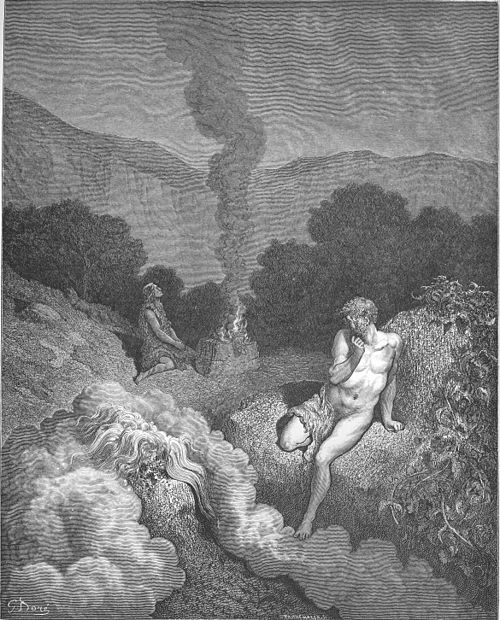
Cain and Abel Offer Their Sacrifices
Gustave Doré

Cain leadeth abel to death tissot
James Tissot

Caïn entraîne Abel (Genesis 4 8) • invenit James Tissot • pinxit James Tissot • excudit Maurice de Brunoff apud Philip de Vere • praesentat Phillip Medhurst.
James Tissot

Châtiment de Caïn (Genesis 4 13) • invenit James Tissot • pinxit James Tissot • excudit Maurice de Brunoff apud Philip de Vere • praesentat Phillip Medhurst.
James Tissot


_%E2%80%A2_invenit_James_Tissot_%E2%80%A2_pinxit_James_Tissot_%E2%80%A2_excudit_Maurice_de_Brunoff_apud_Philip_de_Vere_%E2%80%A2_praesentat_Phillip_Medhurst..jpg)
_%E2%80%A2_invenit_James_Tissot_%E2%80%A2_pinxit_James_Tissot_%E2%80%A2_excudit_Maurice_de_Brunoff_apud_Philip_de_Vere_%E2%80%A2_praesentat_Phillip_Medhurst..jpg)
Source · AI-drafted from public-domain sources (Smith's 1884, Easton's 1897), synthesized + modernized; auto-verified for fidelity. Final gospel.bot review recommended.