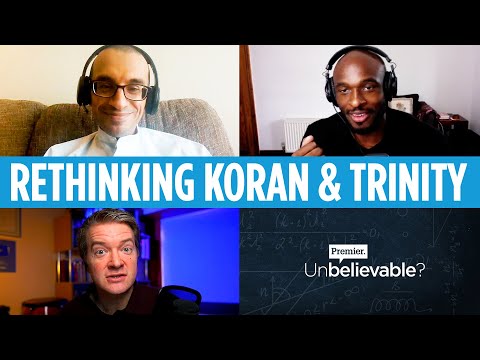
Thomas: (Pt.6) Muhammad isn't in the first SHAHADA!

PfanderFilms
apologetics
January 12, 2022
Thomas has his own channel now here: https://www.youtube.com/channel/UCXPr9Vbibc7wIXJT3_ym-dQ
The Dome of the Rock's 691 AD Inscriptions prove Abd al-Maliks anti-Trinitarian agenda!
Thomas, using Dr Christoph Luxenberg's translation of the 'Dome of the Rock', has done an excellent job of showing us that they are ALL about Jesus' humanity, and against his divinity.
The name 'Muhammad' on the first inscription, once you keep it within the entire context of all of the inscriptions, has nothing to do with a man named Muhammad, but is a reference to 'the Praised one', who is Jesus, someone the inscriptions are insisting is nothing more than a servant and messenger of God.
In slide 1, Thomas points out that the 'Bismillah' in the inscriptions is similar to the Christian 'Doxology', praising the 'one God'. So the word 'Muhammad' or 'Praised be' is a Gerundive Participle who is the Servant of God, and his messenger. So, in the 3rd line, the only time we find the word 'Muhammad' in the inscriptions it should translate as "to him belongs sovereignty and praise".
In slide 2, the inscriptions are all about Jesus, attacking his divinity, the trinity and his son-ship (which later is included in Surah 4:171). So, none of it is about a man named Muhammad, as it's clear that the reference to Muhammad is simply the 'messenger of God'.
In slide 3, the inscriptions is against Jesus' divinity, that he is only a servant and a messenger, attacking differing 7th century Christian doctrines concerning Jesus' Christology, and these inscriptions are later found in the Qur'an in Surahs 19:33, 43:64, and 5:117).
In Slide 4, the inscriptions warn those who don't follow the scriptures, and confronts Jesus' divinity, and wants to put an end to the Christological debate which was rampant at that time.
In Slide 5, the first two verses parallel the 'Sanctus Hymn' which was sung in churches as liturgy, and quotes passages from Isaiah and the Psalms. In the Sanctus Hymn the word for praise "Benedictus", which is the Latin equivalent of the Arabic word 'Muhammad' is properly translated in Latin as "Blessed is he". So, the 'blessed' here is not a name, as that would be 'Benedict'. So, why if in this hymn we translate the same word in Latin as 'Blessed is he', do we then take the Arabic equivalent 'Muhammad' and translate it as a man?
In this same slide, the 2nd line has the 'Shahada', but only the beginning part ('God is one'), and not the latter part ('and the blessed one is his messenger'), which appears 3 lines later in the 5th line. So, why have Muslims today put the two together to form the 'Shahada', since it isn't like that in the first place it is found?
It's obvious that Muslim scholars today have taken a 9th century reference for the name Muhammad, which comes from an 8th century Abbasid narrative about their prophet, and imposed it on this late 7th century text, which was only referring to the 'blessed one' who is obviously about Jesus, since all the other inscriptions are referring only to him.
Taking another later narrative and applying it to the text of an earlier century is called "Eisegesis", and is not proper "Exegesis", which starts from the premise that you always go back to that which the author intended. In this case the author only intended these inscriptions to be about Jesus, and no one else!
© Pfander Centre for Apologetics - US, 2021
(60,380) Music: "Epic Trailer" by Rafael Krux, from filmmusic-io
More from PfanderFilms
View all
 41:28
41:28Grooming Gangs: Scriptural Support gives authority for these atrocities (Episode 2)
PfanderFilms

 20:36
20:36Florian & Dr Jay on the ladder at Speaker's Corner exposing the Qira'at & Riwayats!
PfanderFilms